Rolling-WAM: World Action Models with Rolling Imagination
Sep 24, 2026·, ,,,,,,,,·
1 min read
,,,,,,,,·
1 min read
Yinghua Zhou
Junjie Ye
Yiqi Zhao
Hao Dong
Celina Shiyu Wang
Ruohai Ge
Tingyi Yang
Basile Van Hoorick
Gaurav S. Sukhatme
Vitor Campagnolo Guizilini
Yue Wang
Abstract
World Action Models (WAMs) couple action generation with future visual prediction for robotic manipulation. However, completing the joint video-action denoising process at each replanning cycle incurs substantial latency, delaying action updates and limiting closed-loop responsiveness. We present Rolling-WAM, a formulation that distributes joint denoising across successive replanning cycles. Our method maintains a sliding window of video-action chunks at staggered noise levels. At each step, a rolling noise schedule fully denoises the imminent action chunk for execution, while partially refining farther-future chunks. As the window advances with new camera observations, the retained future chunks continue their denoising process. This distributes the computational cost over time while carrying an evolving visual-action context across chunk boundaries. Evaluations on LIBERO, RoboTwin, and a real-world Unitree G1 humanoid show that Rolling-WAM achieves competitive manipulation performance. By removing the need to denoise the entire prediction horizon from scratch, it delivers a 4.5x steady-state replanning speedup over standard joint WAMs.
Type
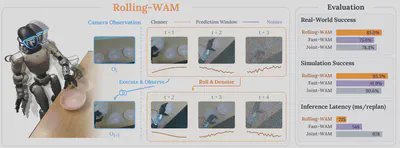
Rolling-WAM project video.