Logic-VLA: A Temporal Logic Conditioned Vision-Language-Action Model
Aug 20, 2026· ,,,·
1 min read
,,,·
1 min read
Celina Shiyu Wang
Yiqi Zhao
Junjie Ye
Yue Wang
Jyotirmoy V. Deshmukh
Abstract
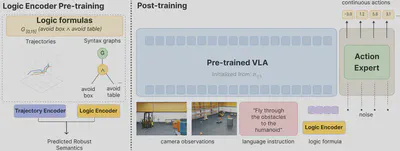
Vision-language-action (VLA) models can follow natural-language (NL) task instructions, but such instructions may not precisely specify safety-critical or spatiotemporal requirements on the resulting behavior. We introduce Logic-VLA, a formal-requirement-aware VLA that conditions on Signal Temporal Logic (STL) specifications supplied at inference time. Logic-VLA uses a syntax-graph-based STL encoder pre-trained to capture temporal logic semantics. Policy adaptation proceeds in two stages. STL-conditioned supervised fine-tuning on satisfying demonstrations is followed by trajectory-level preference optimization over matched satisfying–violating rollout pairs using a flow-matching surrogate for Identity Preference Optimization. This formulation improves formal requirement satisfaction while preserving the nominal NL task. We evaluate Logic-VLA in closed-loop quadcopter navigation simulation across randomized photorealistic environments and test generalization to STL formulas unseen during training. Across the evaluation benchmarks, Logic-VLA improves STL satisfaction rate over an STL-blind base policy by 24.8 to 40.7 percentage points (pp) while reducing nominal NL task success by at most 1.8 pp, showing that a single VLA can adapt its behavior to varying formal requirements without requiring a separate policy for each specification.
Type